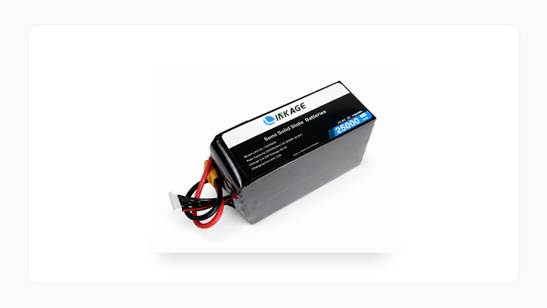
For industrial UAV buyers, semi-solid batteries should be evaluated as complete, integration-ready packs—not only by chemistry labels or headline energy-density figures. Image: LINKAGE / LKGHK official product page.
Data snapshot used in the article
| Topic | Reported figure | Type | Source | Why it matters |
| Tattu semi-solid update | 380Wh/kg | Semi-solid | Official Tattu January 2026 article | Shows semi-solid is still advancing in energy density, not standing still. |
| Tattu semi-solid product | 350Wh/kg; 33Ah; 12S; 44.4V | Semi-solid | Official Tattu product page | A drone-targeted semi-solid pack reference, useful for endurance positioning. |
| LINKAGE 12S pack | 1095Wh; 43.8V; 25Ah; 3C | Semi-solid pack | LKGHK official product page | Pack-level data for VTOL, mapping, inspection and long-endurance UAVs. |
| LINKAGE 6S pack | 1080Wh; 21.6V; 50Ah; 5C | Semi-solid pack | LKGHK official product page | Pack-level data for large 6S industrial UAV platforms. |
| Amprius CES 2026 cell | 520Wh/kg; 1,300Wh/L | Silicon anode | CES Innovation Awards 2026 | A strong cell-level headline showing why silicon anode is a serious challenger. |
| NEO drone field test | 59.2min vs 29.9min; 755Wh pack; 260Wh/kg pack | Silicon-enhanced | NEO Battery Materials February 2026 | Shows the silicon challenge is moving into drone flight-test claims. |
| Silicon anode challenge | Up to 10x graphite capacity; ~300% volume change during cycling | Technical background | PNNL | Explains why silicon is powerful but difficult to stabilize. |
Data note: cell-level Wh/kg and pack-level Wh/kg are separated intentionally. They should not be compared as if they were the same metric.
Why this comparison is becoming a 2026 drone battery story
Silicon-anode drone batteries are getting attention because the headline numbers are difficult to ignore. Public data now includes Amprius’ CES-recognized 520Wh/kg cell, NEO Battery Materials’ silicon-enhanced drone field-test claims, and a wider industry push to move beyond conventional graphite anodes [5][6][7]. For a UAV buyer, those numbers sound like a direct challenge to semi-solid drone batteries. If silicon anode can reach higher cell-level energy density, does the industrial drone market still need semi-solid battery packs?
The short answer is yes, especially when the buyer is building real aircraft rather than reading cell announcements. Silicon anode is a powerful technology direction, but it describes the anode material. Semi-solid describes the battery structure and electrolyte system. They are not perfect opposites. In future designs, they may even overlap. The practical question for industrial UAVs is therefore not ‘which chemistry sounds more advanced?’ It is: which battery architecture gives a drone manufacturer safer, more stable, more documentable and more mission-ready energy at pack level?
That is where semi-solid batteries still have a strong and honest advantage. The best semi-solid UAV packs are not only selling energy density. They are selling a more complete operating window: large watt-hour formats, stable discharge profiles, thermal stability claims, custom pack geometry, practical voltage platforms, and integration-ready documentation for non-standard drones. For exporters, integrators and fleet operators, that can matter more than a single cell-level Wh/kg number.
Silicon anode is the challenger – but it is not the whole battery
Silicon can store much more lithium than graphite, which is why it is attractive for high-energy lithium-ion batteries. PNNL explains the appeal clearly: silicon’s energy capacity can be up to ten times that of commonly used graphite, potentially leading to lithium-ion batteries with 20% to 40% higher energy density [7]. That is a serious advantage for drones, where saved weight can become flight time, payload allowance or landing reserve.
The same source also explains the technical problem. Silicon anodes can expand almost 300% in volume during charging and shrink during discharge, creating stress that can cause cracking, degradation and loss of electrical contact [7]. Advanced silicon-anode companies work hard to solve this through nanostructures, binders, coatings, electrolyte formulations and manufacturing controls. Progress is real, but it is not free.
For drone buyers, the important distinction is cell-level performance versus pack-level performance. A 520Wh/kg cell is impressive, but a UAV battery pack also needs housing, tabs, wiring, connector systems, BMS electronics, insulation, mechanical protection and thermal design. Once those are added, the final pack-level Wh/kg will be lower than the cell-level figure. That is not a weakness of silicon anode; it is the normal physics of making a flight-ready battery.
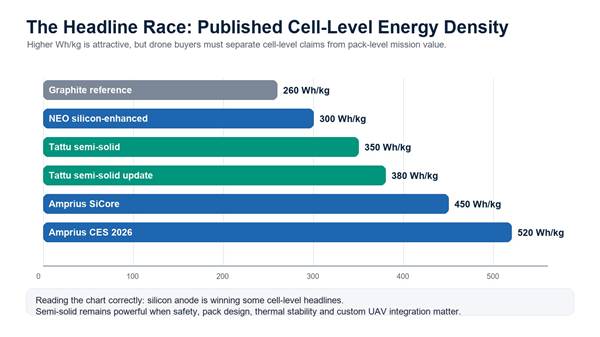
Data chart: silicon-anode cells are winning some headline Wh/kg comparisons, but semi-solid UAV batteries remain strong when the buyer evaluates pack-level mission value. Sources: Tattu, CES, NEO and PNNL.
Semi-solid batteries are not just playing defense
Semi-solid UAV batteries have their own momentum. Tattu announced that its semi-solid-state battery technology had advanced to 380Wh/kg in January 2026 [1]. The company also lists a 350Wh/kg, 33Ah, 12S, 44.4V semi-solid-state smart battery pack for drone use [2]. These figures show that semi-solid is not an old technology waiting to be replaced. It is also climbing the energy-density curve while keeping the conversation closer to UAV pack design.
The real semi-solid advantage becomes clearer when the discussion moves from laboratory cell numbers to aircraft integration. LINKAGE’s 12S 25000mAh semi-solid-state Li-ion battery lists 1095Wh energy, 43.8V nominal voltage and a 3C discharge rating for VTOL, mapping, inspection and long-endurance missions [3]. LINKAGE’s 6S 50000mAh semi-solid-state pack lists 1080Wh, 21.6V and 5C for large 6S UAV platforms [4]. These are not abstract chemistry claims. They are pack-level values that an OEM, distributor or integrator can use when designing a power system.
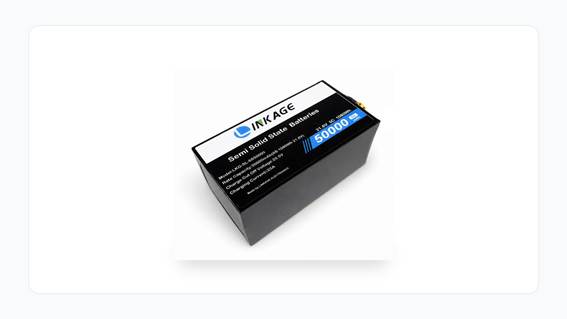
A LINKAGE 6S 50000mAh semi-solid-state UAV battery demonstrates how semi-solid chemistry becomes a practical high-capacity pack for large 6S platforms. Image: LKGHK official product page.
This is a key reason semi-solid remains attractive for non-standard industrial drones. Many UAV projects do not need the most aggressive burst current. They need stable energy, reasonable C-rate, predictable thermal behavior, custom dimensions, reliable connectors, and documentation that can support export sales and after-sales service. A semi-solid supplier can win by solving that practical pack-level problem.
Where silicon anode is strong, and where semi-solid still wins
Silicon anode is strongest when the mission is dominated by energy density and the cell maker has strong control over swelling, cycle life and fast charging. In this role, silicon anode is not hype. It is one of the most serious routes to higher Wh/kg lithium batteries. Amprius’ 520Wh/kg CES 2026 cell and NEO’s reported live drone test, where average flight time increased from 29.9 minutes to 59.2 minutes under stated conditions, show why drone engineers are paying attention [5][6].
Semi-solid is strongest when the buyer needs a balanced UAV pack that can be integrated, transported, documented and supported. Industrial drones often work in heat, cold, vibration, dust and repeated field charging. A battery supplier must provide more than capacity. The buyer needs total watt-hours, nominal voltage, rated capacity, continuous discharge current, peak current duration, working temperature range, recommended charge temperature, cell matching rules, BMS behavior and fault records.
Semi-solid batteries also have a clearer safety story when designed and validated properly. A semi-solid or gel-like electrolyte system can reduce reliance on free-flowing liquid electrolyte and support improved structural and thermal stability, although every pack still needs real testing. This is important because lithium batteries of all types can overheat and undergo thermal runaway if damaged, overheated, overcharged or improperly handled, as the FAA warns [8]. The honest message is not that semi-solid removes risk. The honest message is that semi-solid pack architecture can give UAV teams another tool to manage risk.
Why pack-level reality matters more than the chemistry label
Drone batteries are judged in the air, not in a headline. A UAV pack must deliver power during takeoff, stay stable in cruise, protect the aircraft during voltage sag, tolerate repeated charging, and land with a reserve. This is why buyers should treat cell-level energy-density comparisons as only the first layer of evaluation.
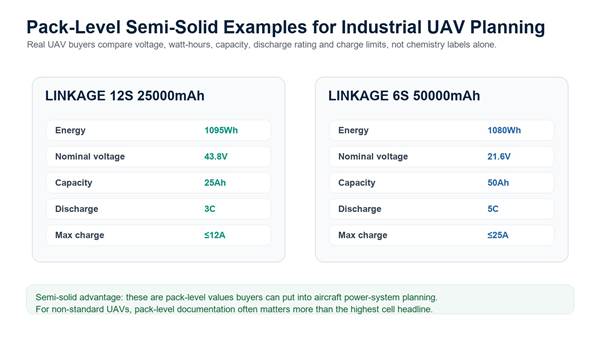
Data chart: pack-level specifications such as watt-hours, voltage, C-rate and charge current are essential for UAV power-system planning. Sources: LKGHK official product pages.
For example, a silicon-anode cell may show a higher Wh/kg number than a semi-solid pack. That does not automatically make it the better UAV battery. If the semi-solid pack offers a practical voltage platform, lower integration risk, better thermal documentation, stable discharge and custom dimensions that fit the aircraft, it may be the better commercial choice. Conversely, if a silicon-anode pack proves better flight time, better cycle life and safe fast charging on the same aircraft, it deserves serious consideration. The winner depends on mission data.
This is also why semi-solid suppliers should avoid weak marketing language. Instead of claiming ‘safer’ or ‘longer endurance’ in isolation, they should show pack-level evidence. State the watt-hours, voltage, capacity, C-rate, charge current, temperature range, BMS functions, cycle test conditions and flight-test method. In export markets, clear specifications often create more trust than dramatic claims.
Best-fit UAV applications for semi-solid packs
Semi-solid UAV batteries are especially convincing in long-endurance industrial platforms where energy reserve and stability matter more than extreme burst power. Fixed-wing VTOL mapping drones, inspection UAVs, patrol aircraft, communication relay drones and moderate-payload multirotors all need predictable energy over mission time. In these applications, a high-capacity semi-solid pack can reduce battery swaps, extend route coverage and simplify field logistics.
They are also well suited to non-standard UAV projects. Many overseas buyers are not purchasing a consumer drone battery; they are building aircraft around special payloads, battery bays, connectors, voltage platforms and mission requirements. A semi-solid supplier that can customize 6S, 12S, 14S or other pack formats has a real advantage because the battery can be engineered around the aircraft instead of forcing the aircraft to accept a generic pack.
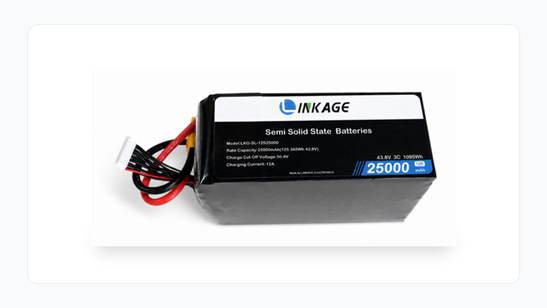
High-voltage 12S semi-solid battery formats are relevant for VTOL, mapping, inspection and patrol UAV projects that need custom integration. Image: LKGHK official product page.
For drone dock operations, semi-solid packs may also be valuable if the system requires predictable charging and thermal behavior. Drone-in-a-box fleets care about turnaround time, battery health records and safe unattended charging. Silicon anode may improve energy density in this category, but semi-solid pack engineering can still be the easier message to validate for fleet operators: stable pack format, documented BMS, defined charge current, and a safety-first structure.
What serious buyers should ask before choosing either technology
The right procurement checklist should be technical, not emotional. First, ask whether the quoted energy density is measured at cell level or pack level. Then request total watt-hours, nominal voltage, rated capacity, continuous discharge current, peak-current duration, working temperature range and recommended charging temperature. These numbers determine whether the battery can actually support the aircraft.
Next, ask about the battery management system. A professional UAV pack should ideally support multi-point temperature sensing, BMS data logging, cycle count, state-of-health estimation and fault records. For international buyers, this is not a luxury. It helps distributors, OEMs and fleet operators diagnose problems without guessing.
Finally, ask for realistic flight-test evidence. The test report should include aircraft model, payload mass, takeoff weight, weather assumptions, route profile, landing reserve and the exact comparison battery. Without these details, a flight-time claim is difficult to use in commercial planning. This applies equally to silicon-anode and semi-solid batteries.
How semi-solid suppliers should position the advantage honestly
For a semi-solid battery exporter, the most effective message is not ‘silicon anode is bad.’ That would sound defensive and technically weak. A stronger message is that industrial UAV customers should not buy a chemistry label; they should buy a validated power system. Silicon anode is an important trend, but semi-solid packs can still offer a more practical route when the project requires non-standard size, stable discharge, documented safety design and repeatable pack-level supply.
The sales language should stay close to engineering reality. Instead of saying ‘our battery is the safest,’ say what can be verified: semi-solid architecture supports improved structural and thermal stability; the pack is available in defined voltage and capacity formats; the discharge rating is suitable for endurance and utility missions; custom pack design can match UAV battery bays, connectors and BMS requirements; and flight-test validation can be prepared for the customer’s aircraft.
This type of positioning is attractive to overseas buyers because it reduces risk. European, North American, Middle Eastern and Asian UAV integrators often need battery partners who can discuss compliance, shipping, storage, charging, after-sales diagnosis and product customization. A supplier who explains semi-solid advantages with specific data will look more credible than one who only promises ‘longer flight time.’ In Google content, credibility is a conversion tool.
A realistic conclusion: silicon is a challenge, not a replacement
Silicon-anode drone batteries are absolutely challenging the market. Their headline energy-density numbers are strong, and recent drone field-test claims make them impossible to ignore. But the idea that silicon anode will simply replace semi-solid batteries is too simple. One is mainly an anode strategy. The other is a cell and pack architecture strategy. They answer different parts of the UAV battery problem.
For industrial drones, semi-solid batteries still offer a powerful practical advantage: they can be sold, customized and validated as complete pack-level energy systems. That matters for long-endurance UAVs, VTOL mapping aircraft, inspection platforms, patrol drones and other non-standard applications where the buyer needs more than a cell number.
The strongest future may combine both directions: silicon-enhanced materials inside safer, more stable, semi-solid or quasi-solid architectures. Until then, semi-solid suppliers should not fight the silicon-anode trend with vague claims. They should win with transparent data, real pack specifications, thermal design, BMS documentation and flight-test proof. For serious UAV buyers, that is the difference between a battery headline and a battery that can fly missions.