Drone endurance has always been a hard engineering limit. Motors can become more efficient, airframes can become lighter and flight software can become smarter, but the battery still decides how far a UAV can go before payload, wind, reserve and safety margins pull it back to earth. That is why a new solid-state drone battery announcement is getting attention in 2026: Factorial Energy and Tulip Tech reported that initial customer flight testing showed more than a 30% increase in flight range before any engineering optimization [1].
For drone manufacturers, fleet operators and battery buyers, the headline is exciting. A 30% range gain can change the mission value a drone can deliver: more inspection distance, fewer battery swaps, larger reserve, heavier payload or better mission confidence. But it should not be read as a universal guarantee that every aircraft will fly 30% farther with any solid-state pack. A serious buyer should ask a deeper question: what did the test prove, what remains unproven, and how should solid-state UAV batteries be evaluated before procurement?
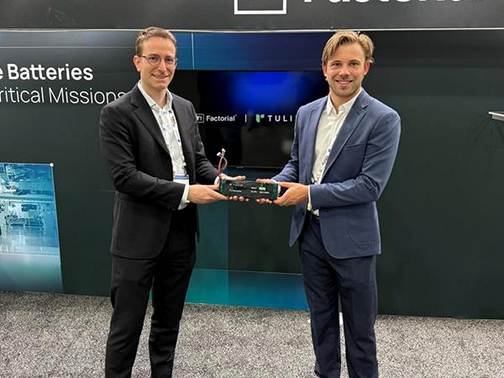
Factorial and Tulip Tech presented their partnership after an initial drone flight demonstration. Image: Factorial Energy / GlobeNewswire attachment.
Data snapshot used in this article
| Topic | Reported figure | Type | Source | Why it matters |
| Initial solid-state drone flight testing | More than 30% increase in flight range before engineering optimization | Company-reported flight-test result | [1] | The key news hook, but it should be read as an early project result, not a universal performance guarantee. |
| Strategic production target | Up to 500,000 drone systems over a multi-year period | Company-stated partnership target | [1] | Shows why the announcement matters commercially if the program scales. |
| Monthly production ambition | Potential scale-up to 100,000 battery packs per month once the first phase begins | Company-stated future target | [1] | Useful for market context, but not proof of current mass production. |
| Tulip market position | More than 250 customers in defense, security, inspection, agriculture and logistics | Company statement | [1] | Shows the range of UAV applications where longer endurance is valuable. |
| Tulip endurance claim | Drone battery solutions described as enabling 30% to up to 100% further flight | Supplier marketing claim | [3] | Relevant to positioning, but should be validated by aircraft-specific tests. |
| Prior high-energy UAV case | DeltaQuad Evo flight-time extension up to 8 hours; 450 Wh/kg high-energy silicon-anode batteries | Supplier case study | [4] | Shows why flight data and chemistry details must be separated. |
| FAA Part 107 active sUAS fleet | 424,516 active aircraft in 2025; base forecast 540,845 by 2030 | Official forecast | [5] | Shows why battery endurance and documentation matter as fleets scale. |
| FAA large UAS forecast | 8,295 active large UAS in 2025; 55,509 by 2030; 46.3% CAGR | Official forecast | [5] | Large UAVs make battery cost, safety, energy and pack-level integration more important. |
| Lithium battery safety context | FAA tracks known events involving smoke, fire or extreme heat; page last updated 16 July 2026 | Official safety data page | [6] | Supports a cautious safety discussion without overstating risk. |
Why the 30% flight-range headline matters
A 30% flight-range improvement is not a small number in industrial drones. If a UAV normally flies a 40 km inspection route, a 30% improvement could turn that into roughly 52 km under comparable conditions. If the operator keeps the route fixed, the same improvement could instead become a larger landing reserve. For some customers, reserve is more valuable than absolute range because it reduces mission risk when wind, temperature or payload changes during the day.
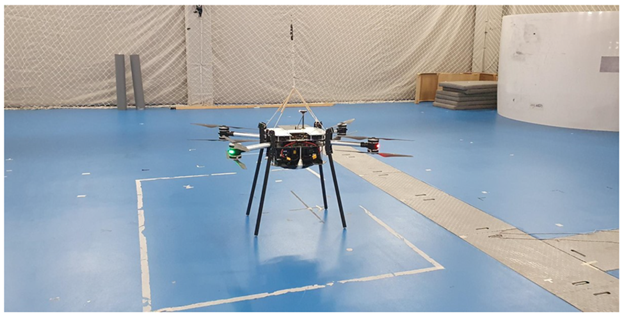
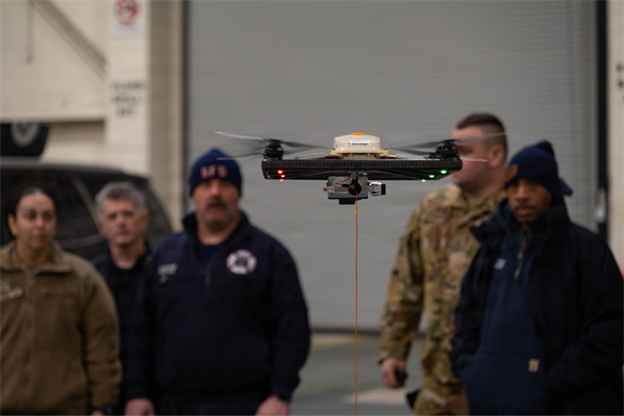
The Factorial-Tulip announcement is also important because it connects solid-state battery technology with a real aerial platform use case. Many battery announcements stay at the cell level: energy density, cycle life, fast charge or laboratory safety. Drone buyers need more than a beautiful cell number. They need a battery system that can survive vibration, discharge peaks, field charging, connectors, packaging, BMS logic, transport documents and repeatable flight-test evidence.
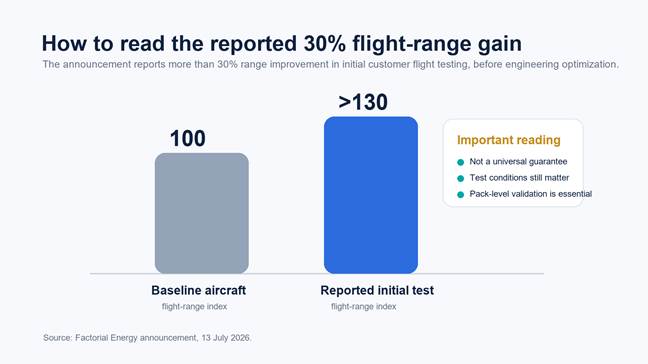
The reported result is best understood as a flight-range index: 100 baseline versus more than 130 after initial testing, before engineering optimization. Source: Factorial Energy announcement.
The important caveat: range gain is aircraft-specific
Flight range is not a chemistry-only outcome. It depends on pack weight, pack volume, voltage platform, discharge behavior, airframe efficiency, payload mass, wind, flight profile, reserve policy, BMS settings and temperature. That is why a credible 30% range claim should always come with test conditions. What was the aircraft model? What was the payload? Was the test measuring range, endurance time or useful mission radius? Was the comparison made against a conventional Li-ion pack, LiPo pack or another prototype? What landing reserve was used?
This does not weaken the announcement. It makes the announcement more useful. Early flight tests are exactly how new battery chemistries move from the laboratory into the aircraft. But for buyers, one test should open the due-diligence process, not close it. A good supplier should be comfortable sharing realistic assumptions and should avoid turning one aircraft result into a blanket promise for every UAV.
Solid-state is promising, but the pack still decides the mission
Solid-state batteries are attractive because they can support high energy density, potential safety improvements and lithium-metal designs that challenge conventional graphite-anode lithium-ion cells. Factorial’s broader 2026 messaging emphasizes solid-state and lithium-metal battery solutions for drone applications, working with integrators across North America, Europe and Asia [2]. Tulip’s website also positions high-energy drone battery systems as a way to extend flight distance and support custom UAV requirements [3].
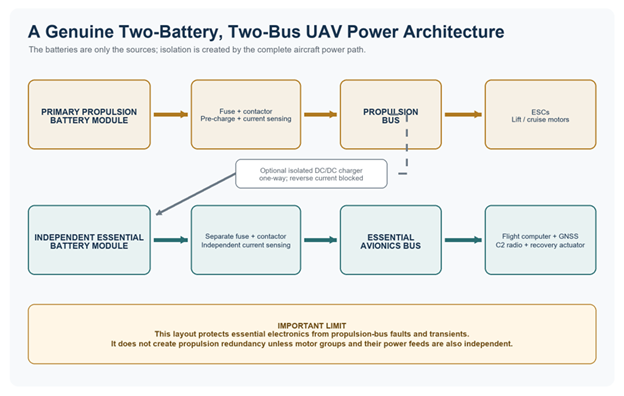
The engineering challenge is that drones do not fly cells. They fly packs. A flight-ready battery needs mechanical protection, terminals, wiring, insulation, BMS, temperature sensing, charge limits, discharge limits, enclosure design and documentation. The pack-level Wh/kg is always lower than the best cell-level Wh/kg because the aircraft must carry all of those extra components. For a drone OEM, a slightly lower energy-density pack with stable discharge, clean BMS communication and proven integration can be more valuable than a headline cell that is not yet ready for the aircraft.
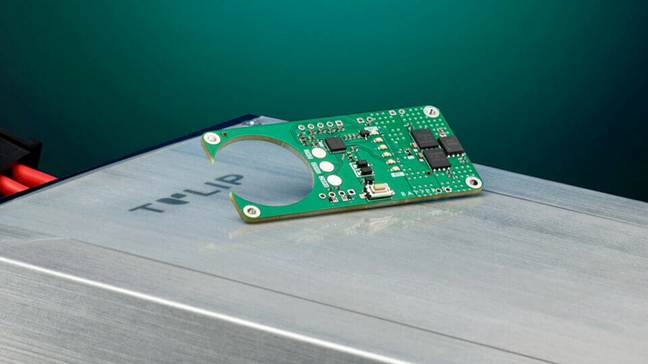
Battery chemistry becomes useful to drone buyers only when it is integrated into a pack with BMS, mechanical design and application-specific validation. Image: Tulip Tech official website.
What the announcement means for industrial UAV buyers
The first lesson is simple: endurance competition is moving from marketing claims to flight evidence. A supplier that can show real aircraft tests, payload details and reserve assumptions will be more credible than a supplier that only shows a cell datasheet. The best procurement conversations in 2026 are no longer about asking ‘is it solid-state?’ They are about asking ‘what can this battery prove at pack level, in my aircraft, under my mission conditions?’
The second lesson is that solid-state may arrive first in high-value missions where extra endurance justifies extra engineering work. Defense, security, long-range inspection, emergency response, logistics and mapping all reward longer mission radius. Tulip describes customers across defense, security, inspection, agriculture and logistics [1]. Those are exactly the segments where a battery that adds real usable range can change mission economics.
The third lesson is that safety language must stay honest. Solid-state designs may reduce some risks associated with liquid electrolyte in certain architectures, but no lithium battery should be marketed as risk-free. The FAA’s lithium battery incident page tracks known events involving smoke, fire or extreme heat and explicitly notes that the list is not a complete record of all incidents [6]. For industrial UAVs, safety is not a slogan. It is a chain: cell design, pack design, BMS, charging method, storage practice, shipping compliance and operator training. For export shipments, the IATA 2026 Lithium Battery Guidance Document remains a practical reference for current air-transport requirements and packaging logic [7].
How to evaluate a solid-state UAV battery supplier
A serious buyer should turn every solid-state battery claim into a short engineering checklist:
- Energy-density basis: ask whether the quoted Wh/kg is measured at cell level or pack level.
- Pack specification: ask for total watt-hours, nominal voltage, rated capacity, continuous discharge current, peak current duration, working temperature range and recommended charge temperature.
- Battery intelligence: ask whether the pack includes multi-point temperature sensing, BMS data logging, cycle count, state-of-health estimation and fault records.
- Export readiness: ask for UN38.3 documentation, transport classification, packaging method and any air-shipping limits that affect international delivery.
These questions turn a battery conversation from hype into engineering.
Flight-test data should be treated the same way. Ask for the aircraft model, payload mass, weather assumptions, route profile, average speed, landing reserve and comparison battery. If the supplier reports a percentage gain, ask what the baseline was. If the supplier reports a long endurance time, ask whether it was a hover test, cruise test, route mission or record-style demonstration. Drone batteries live in context.
Production questions matter too. The Factorial-Tulip announcement mentions a strategic production target of up to 500,000 drone systems over a multi-year period and possible scale-up to 100,000 battery packs per month once the first phase begins [1]. Those are meaningful commercial signals, but they are still forward-looking. Buyers should ask what is available now, what is pilot production, what is contracted, what is qualified, and what documentation comes with each shipment.
Where semi-solid and high-energy lithium packs still fit
The rise of solid-state drone batteries does not make other high-energy UAV packs obsolete overnight. Many drone builders need practical solutions today: custom voltage, custom dimensions, reliable connectors, realistic C-rate, BMS support, UN38.3 documentation and predictable lead time. Semi-solid and high-energy lithium-ion packs can still be attractive when they are available, well-documented and matched to the aircraft’s actual power profile.
For exporters, this is a useful positioning point. The market is clearly moving toward higher energy density and better safety architecture, but buyers still need a supplier who can translate chemistry into a working pack. Whether the chemistry is solid-state, semi-solid, lithium-metal, silicon-enhanced or conventional lithium-ion, the winning supplier will be the one that can provide evidence, not just adjectives.
A realistic roadmap for drone battery development
The future of drone batteries will probably not be one chemistry replacing all others at once. More likely, the market will split by mission. Small consumer drones will prioritize cost and convenience. Industrial multirotors will prioritize usable Wh, safe discharge and battery turnover. Long-range fixed-wing and VTOL aircraft will chase energy density, pack integration and certification. Autonomous drone docks will care about charging behavior, cycle life and data logging. Large UAVs will care about documentation and reliability because the battery becomes a higher-value aircraft component.
This is why the 30% solid-state flight-range result matters. It is not only a news headline. It is a sign that drone battery competition is entering a more serious stage, where the best claims must survive real flights. The companies that win will not simply say ‘solid-state.’ They will show pack-level specifications, thermal strategy, BMS behavior, flight-test assumptions, transport readiness and lifecycle support.
Conclusion
The Factorial-Tulip flight-test announcement gives the drone battery market a strong new talking point: solid-state technology is moving closer to practical UAV use. A reported range gain of more than 30% before optimization is worth attention, especially for high-value industrial missions. But the smartest buyers will not stop at the headline. They will ask how the battery performs as a complete pack, in a real aircraft, with a real payload, under real operating limits.
That is the real opportunity for drone battery suppliers. The future will reward companies that combine chemistry, BMS, safety documentation, pack engineering and honest flight data. In the next phase of UAV power, credibility may become just as important as energy density.
Sources
[1] Factorial Energy. “Factorial and Tulip Seal Strategic Partnership After Successful Initial Drone Flight Demonstration.” 13 July 2026. https://ir.factorialenergy.com/news-releases/news-release-details/factorial-and-tulip-seal-strategic-partnership-after-successful
[2] Factorial Energy. “Factorial Partners with Top Integrators Across Three Continents.” 21 May 2026. https://ir.factorialenergy.com/news-releases/news-release-details/factorial-partners-top-integrators-across-three-continents
[3] Tulip Tech. Official homepage and battery-technology description. https://www.tulip.tech/
[4] Tulip Tech. “Flight Data: Exploring High Energy Drone Battery Technology.” https://www.tulip.tech/flight-data-exploring-high-energy-drone-battery-technology/
[5] Federal Aviation Administration. “Compendium to FAA Aerospace Forecast 2026-2046: Emerging Aviation Entrants – Analysis and Forecasts: Unmanned Aircraft Systems and Advanced Air Mobility.” https://www.faa.gov/data_research/aviation/aerospace_forecasts/uas-compendium.pdf
[6] Federal Aviation Administration. “Lithium Battery Incidents.” Last updated 16 July 2026. https://www.faa.gov/hazmat/resources/lithium_batteries/incidents
[7] IATA. “Lithium Battery Guidance Document, 2026.” https://www.iata.org/contentassets/05e6d8742b0047259bf3a700bc9d42b9/lithium-battery-guidance-document.pdf