A tethered drone backup battery is not redundant weight: it is the aircraft's last controlled path to the ground when tether power fails. The tether may keep an industrial drone airborne for hours, but it also creates a power chain with multiple single-point failures.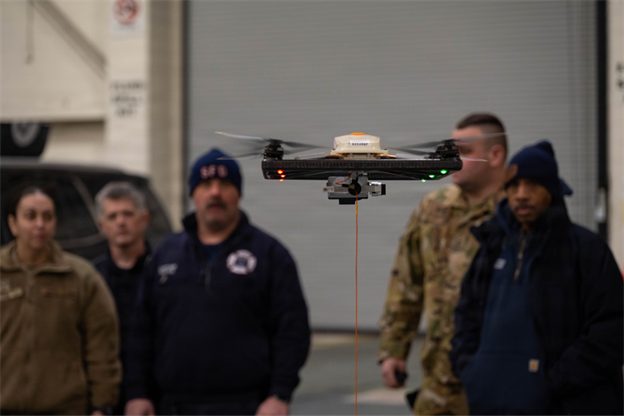
A tethered multirotor operating during a 2026 training session. Persistent flight does not eliminate the need for an onboard emergency power source. Source: U.S. Air National Guard / DVIDS, public domain
Tethered drones are moving from specialist prototypes into persistent observation, temporary communications, emergency response, industrial inspection and site-security roles. A 2025 communications study, for example, demonstrated continuous wired power for emergency-network services (Rodriguez et al., 2025). Their appeal is easy to understand: instead of lifting all mission energy, the aircraft receives power from a ground station through a conductive cable.
A 2021 research hexacopter demonstrated four hours of continuous operation at heights above 50 metres (Chang and Hung, 2021). Separately, a 2025 review of 160 peer-reviewed publications described the tether as a combined power, data, sensing and mechanical element rather than a simple cable (Fattori and Cocuzza, 2025).
That endurance advantage can hide a dangerous assumption: if the drone is connected to continuous ground power, why carry a battery? The answer is that the tethered power chain can still fail, and a multirotor cannot glide. When the chain opens, the aircraft must keep its flight controller alive, maintain enough thrust to stabilise, and retain sufficient energy for a controlled descent and landing. Those tasks require both rapid power transfer and a battery pack designed for the actual emergency mission.
The tether removes an endurance limit—not every failure mode
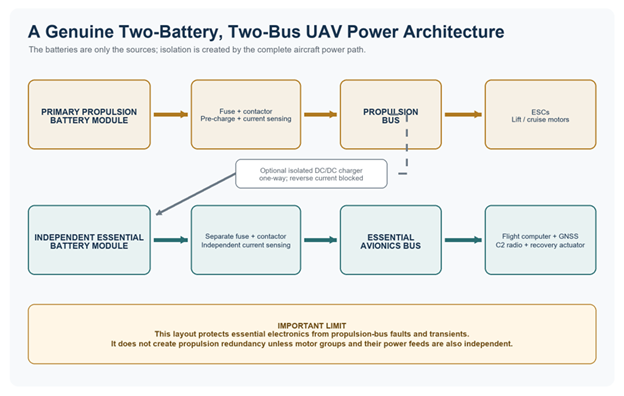
A typical system contains more than a cable. It may include the utility connection or generator, rectifier, ground-side power supply, protection devices, tether reel, slip ring, connectors, high-voltage conductors, onboard converter and low-voltage distribution bus. Mechanical damage, an unplugged connector, generator shutdown, converter over-temperature protection, a reel fault or a broken conductor can interrupt the path. New research on differential-current monitoring for multi-core UAV cables reflects how seriously engineers are treating cable-health detection (Chen et al., 2025). Detection, however, is only half of the safety case. The aircraft still needs energy after the fault is detected.
The correct design question is therefore not whether a tethered drone needs a battery. It is what the battery must guarantee, how quickly it must be connected, and how the complete power architecture behaves during the transition. For most industrial systems, the battery’s primary job is not to support the full tethered mission. Its job is to bridge the interruption, preserve control authority and complete a defined emergency profile.
What the millisecond switching study actually proved
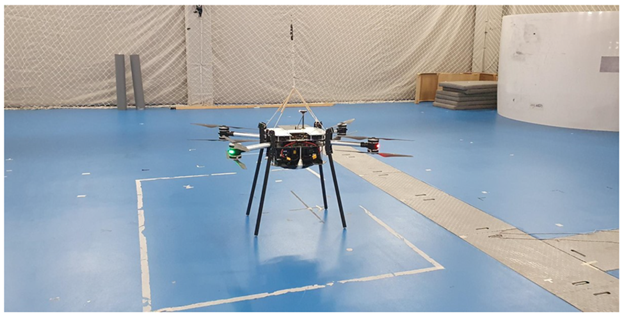
A 2025 open-access study in the Ain Shams Engineering Journal provides unusually useful evidence. The researchers built an AC-powered tethered quadrotor with a MOSFET-based hybrid switching circuit, a 3S 1,800 mAh 50C LiPo backup battery and a small supercapacitor group dedicated to the autopilot. The circuit detected the loss of wired power and connected the battery without requiring a manual command (Ünler, 2025).
The detailed programme included 135 switching measurements: 15 tests for each combination of three temperatures—0°C, 25°C and 50°C—and three load levels—50%, 75% and 100%. Average delay rose with temperature and load, from 0.573 ms at 0°C and 50% load to 1.220 ms at 50°C and full load. Across the reported experiments, recorded switching times ranged from 0.560 to 1.296 ms. The aircraft experienced a voltage dip rather than a sustained power loss, and the authors reported no effect on the tested UAV’s operation.
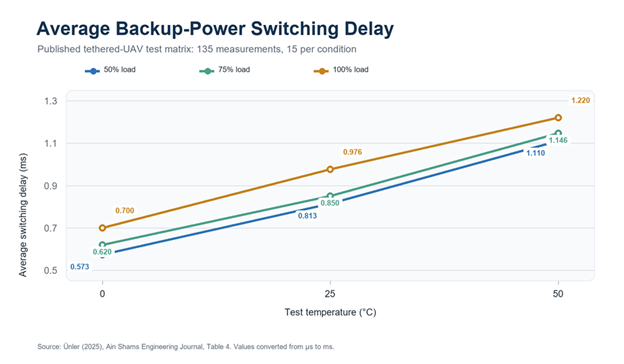
Average switching delay increased with temperature and load but remained below 1.3 ms across the published prototype tests. Source: Ünler (2025), Table 4
The study is important, but it should not be turned into a universal marketing claim. The result belongs to one prototype, one circuit, one battery and one test setup. A larger aircraft, different DC bus, longer harness, higher inductance, aged cells or different protection logic may behave differently. The engineering lesson is not that every tethered UAV can switch in 1 ms. It is that interruption time is measurable, fault injection is practical, and the result must be validated at the aircraft level.
| Published test item | Reported value (Ünler, 2025) |
| Switching tests | 135 measurements; 15 repetitions at each temperature-load condition |
| Detailed test matrix | 0°C, 25°C and 50°C at 50%, 75% and 100% load |
| Recorded delay range | 0.560-1.296 ms across the reported experiments |
| Prototype power demand | 89.44 A and 1,051 W calculated at full performance |
| Backup battery | 3S 1,800 mAh, 50C, 142 g; selected for a one-minute emergency case |
| Complete backup assembly | 248.7 g including battery, switching PCB and supercapacitors |
A backup battery needs power first, then enough energy
Emergency-pack discussions often begin with watt-hours. For a multirotor, that is incomplete. The pack must first supply enough current at its lowest expected loaded voltage to keep the aircraft controllable. It must then sustain the required descent, manoeuvre and landing time with reserve. A battery can contain enough nominal energy and still fail the mission if voltage sag triggers an ESC or flight-controller undervoltage threshold during a thrust correction.
In the published prototype, four motors and onboard electronics produced a calculated full-performance demand of 89.44 A and 1,051 W. The researchers selected a 50C, 1.8 Ah battery because the nameplate arithmetic—1.8 Ah multiplied by 50C—gave 90 A. Their one-minute emergency calculation required 1.5 Ah; after adding a 10% margin, the minimum became 1.65 Ah, leading to selection of the nearest 1.8 Ah pack. This is a clear example of sizing current capability and emergency duration together. It is not a generic recommendation for other airframes.
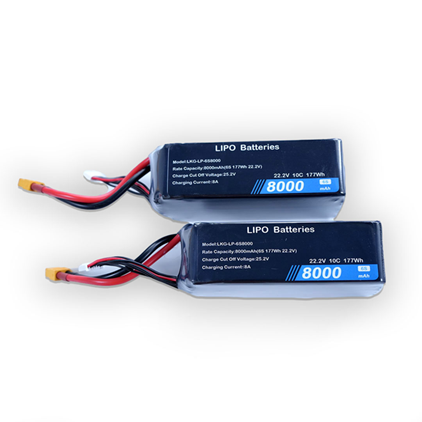
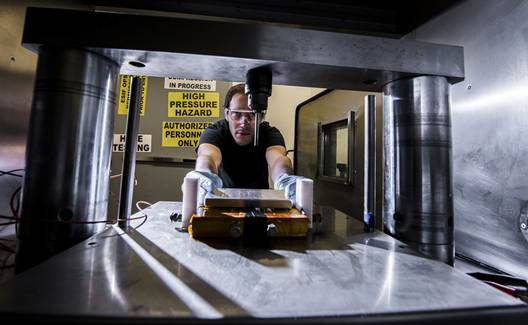
Illustrative soft-pack 6S UAV battery; this is not the 3S 1,800 mAh pack used in the published prototype. A tethered-drone backup battery must be sized from the aircraft’s emergency load trace, bus voltage and landing reserve. Source: LINKAGE product photograph
For another platform, engineers should use the measured emergency current profile rather than motor datasheets alone. At minimum, calculate required nameplate energy from the time integral of bus power, divided by conversion efficiency and the permitted usable fraction. Then verify peak power at cold temperature, low state of charge and end of service life. As a transparent illustration, a 1.2 kW average emergency load sustained for three minutes consumes 60 Wh before losses. At 90% power-path efficiency and an 80% usable-energy limit, the starting nameplate requirement becomes about 83 Wh—before adding aircraft-specific cold, ageing or contingency margins.
Why direct parallel connection is not a complete architecture
Simply connecting the tether supply and battery in parallel may appear to create automatic redundancy, but it can also permit uncontrolled charging, reverse current and poor current sharing. If bus voltage exceeds battery voltage, the battery may be charged without the intended charge profile. If the two sources are closely matched, cable and connector resistance can determine current distribution. Faults may also propagate between sources unless they are isolated. The 2025 switching study explicitly identified uncontrolled parallel charging as a safety and life concern and instead activated the battery only when wired power failed.
A production design may use MOSFET ideal-diode control, contactors, solid-state switching, a controlled DC/DC path or a coordinated combination. The correct topology depends on bus voltage, current, required transfer time and failure analysis. It should prevent backfeed, manage inrush current, tolerate sensor faults and provide a predictable state when control power is lost. A small supercapacitor or separately protected low-voltage rail can keep the autopilot and communications alive while the propulsion bus transfers, but it cannot replace the energy needed to land.
The landing reserve must be a defined mission
‘Enough energy to land’ is not a specification until the landing scenario is defined. A drone hovering 15 m above a clear pad has a different requirement from one supporting a telecom payload at 100 m in gusty wind. Some systems can descend almost vertically along the tether; others must stabilise, release or manage tether tension, avoid obstacles, or fly to an alternate point. The reserve should include fault recognition, controller transition, stabilisation, descent, flare or touchdown, and a policy for a blocked landing zone.
The battery must also be available after hours at a high state of charge without being damaged by unsuitable float charging. That creates a lifecycle problem different from a normal flight battery. The pack may spend most of its life waiting and only occasionally delivering a high-power emergency discharge. Storage state of charge, periodic self-test, cell balance, connector integrity and capacity verification therefore matter as much as cycle count. A system that reports ‘battery connected’ but cannot prove remaining power capability is not truly redundant.
What a serious validation programme should include
The strongest evidence is an aircraft-level fault-injection test, not a cell datasheet or bench-only capacity result. The objective is to show that the aircraft remains controllable through the complete worst-case transition. A practical programme should combine electrical, thermal, mechanical and operational checks.
- Power interruption: open the ground input, disconnect the tether, trip the onboard converter and simulate brownout rather than testing only one failure point.
- Worst-case battery state: repeat at minimum allowed state of charge, cold temperature, elevated temperature and an aged-pack condition representative of retirement limits.
- Dynamic load: include hover, gust rejection, controlled descent, go-around or obstacle avoidance, because a static resistor does not reproduce motor transients.
- Bus integrity: record voltage at the battery, switching stage, ESC input and avionics rail with sufficient oscilloscope bandwidth to capture the transfer event.
- Fault containment: verify no reverse current, uncontrolled charge, contactor chatter, BMS reset or common-mode loss of both sources.
- Mechanical integration: test vibration, connector retention, cable strain relief, enclosure temperature and electromagnetic compatibility near GNSS and flight-control hardware.
- Landing outcome: measure remaining energy and minimum loaded cell voltage after the worst-case landing, not merely whether the motors continued spinning on the bench.
The published prototype offers a useful benchmark because it combines repeated measurements with multiple temperatures and loads. Buyers should request the same kind of traceable evidence from their own system: aircraft model, take-off mass, payload, tether length, bus voltage, emergency current trace, ambient conditions, battery age, landing time and reserve at touchdown.
A better RFQ for a custom tethered-drone battery
For OEMs and integrators, a useful battery request begins with the aircraft and failure case—not capacity alone. The RFQ should define six groups of requirements:
- Electrical interface: nominal and maximum bus voltage, permitted voltage sag and protection thresholds.
- Load profile: hover, descent and peak current, together with the duration of each peak.
- Emergency mission: required transfer, stabilisation, descent and landing time, including reserve at touchdown.
- Operating environment: minimum and maximum temperature, altitude and expected weather exposure.
- Mechanical integration: maximum battery mass and envelope, connector type, cable routing and retention requirements.
- Lifecycle and communication: charge strategy while tethered, data interface and required service-inspection interval.
Then ask the supplier for pack-level data: measured discharge curves under the intended pulse profile, cell-to-cell voltage spread, temperature locations, BMS thresholds, switch and connector current ratings, end-of-life power capability and fault records. If the aircraft uses a supercapacitor for avionics ride-through, treat that as a separate verified layer rather than subtracting it from propulsion reserve. The final acceptance test should use the customer’s aircraft or a representative power emulator and should include an intentional ground-power failure.
The battery is small, but its safety role is large
Tethered drones can deliver the persistent flight that many industrial missions need. Yet long endurance does not make the aircraft battery-free; it changes the battery’s job. The pack becomes a standby, high-power safety component that must wake instantly, hold the bus through transients and complete a defined landing mission.
For OEMs and procurement teams, a tethered drone backup battery should be treated as a verified safety subsystem, not as optional endurance mass. The most credible design is built on three layers: fast source transfer, protected avionics ride-through and a validated lithium battery reserve. Millisecond switching data are valuable, but they are only one part of the proof. The decisive question is not ‘Does the drone carry a backup battery?’ It is ‘Has the complete aircraft demonstrated a safe landing after the tether power was deliberately removed under the worst credible conditions?’