For years, many drone operators treated lithium battery packs as consumables: buy them, fly them, mark the cycle count by hand, retire the weak ones when performance feels unsafe. That approach may still work for hobby aircraft or small test fleets. It does not scale well for industrial UAVs that inspect powerlines, map infrastructure, spray crops, monitor security zones, or carry expensive payloads. In those missions, the battery is no longer just a replaceable energy block. It is a flight-critical data source.
That is why Smart BMS and SOH are becoming a more important drone battery topic in 2026. BMS means battery management system. SOH means state of health, usually an estimate of how much useful capacity or performance remains compared with a fresh pack. The value is not only in a screen that says 92 percent. The value is in the evidence behind that number: voltage behavior, current load, temperature history, imbalance, cycle count, fault records, charge behavior, storage conditions and real mission logs.

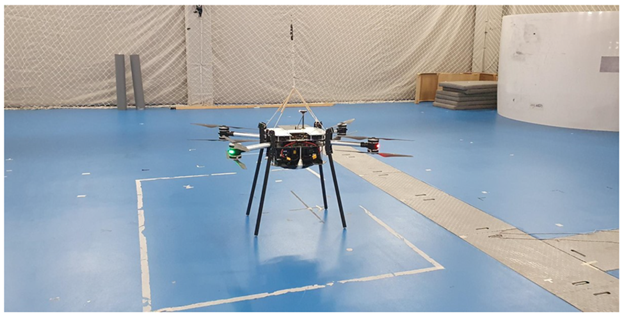
Industrial UAV fleets create repeatable power-data problems: every aircraft, payload, route and landing reserve changes how the battery ages. Image: NASA / Ames, public NASA image page.
Data snapshot used in this article
| Topic | Reported figure | Source | How it is used in the article |
| Recent UAV SOH research | 342 and 289 flight experiments on 2200 mAh and 1100 mAh LiPo batteries | [1] | Shows that UAV-specific SOH prediction is becoming a real research topic, not only an EV topic. |
| SOH model inputs in that study | Voltage, current and throttle; remaining capacity measured every 10th experiment | [1] | Supports the argument that useful SOH depends on logged operational signals. |
| FAA Part 107 active sUAS fleet | 424,516 active aircraft in 2025; base forecast 540,845 by 2030 | [2] | Shows why battery records become more important as drone fleets scale. |
| FAA large UAS fleet forecast | 8,295 active lUAS in 2025; 55,509 by 2030; 46.3% CAGR | [2] | Shows the growth of larger platforms where battery cost, risk and documentation matter more. |
| FAA lithium battery safety page | Events involving smoke, fire or extreme heat; page last updated 16 July 2026 | [3] | Supports a cautious safety discussion without overstating incident totals. |
| EU Battery Regulation Article 14 | From 18 August 2024, BMS SOH and expected-lifetime data are required for stationary BESS, LMT and EV batteries | [4] | Shows that battery data access is becoming a regulatory expectation in adjacent battery categories. |
| EU Battery Regulation Article 77 | From 18 February 2027, battery passports apply to LMT, EV and industrial batteries above 2 kWh | [4] | Relevant to large industrial battery packs, while noting that not every drone pack is automatically in scope. |
| Example high-capacity UAV pack | LINKAGE LKG-SL-6S80000: 80,000 mAh, 6S, 21.6 V, 1,728 Wh, 5C | [5] | Used as a manufacturer product example of pack-level data fields buyers can verify. |
| Battery aging reference | NASA battery-aging data are widely used for degradation and remaining-useful-life research | [6] | Supports the idea that battery health is a measurable life-cycle problem. |
The hot topic is not more electronics. It is trusted battery data.
A basic BMS protects a battery pack from obvious abuse: over-voltage, under-voltage, over-current and excessive temperature. A smarter BMS does more than protect. It records what happened. That difference matters because industrial drone batteries rarely age in a clean laboratory pattern. Two packs with the same rated capacity can age differently if one is used on a heavy-lift mission in hot weather, one sits fully charged for weeks, and one is repeatedly charged in the field before it cools down.
The newest UAV battery conversation is therefore moving from chemistry labels to operational evidence. Energy density still matters. Discharge rate still matters. Semi-solid, high-energy lithium-ion, silicon-enhanced and LiPo designs all have roles. But for a fleet manager, the purchase question is becoming more practical: can the supplier help me understand the pack after 50, 100 or 200 missions? Can the BMS record enough history to explain why a pack should keep flying, be downgraded to lighter duty or be retired?
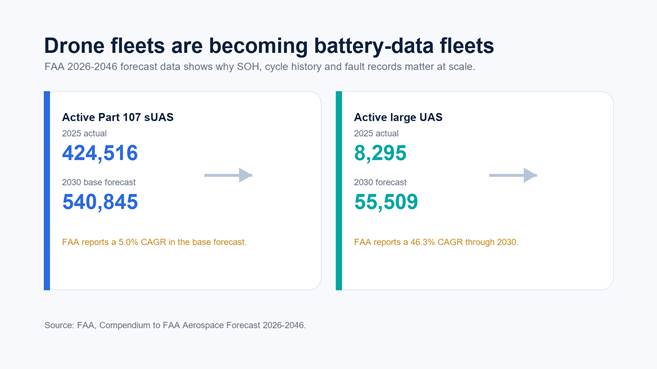
FAA fleet forecasts show why drone batteries are becoming asset-management tools, not anonymous consumables. Source: FAA UAS Compendium 2026-2046.
Why SOH matters more for UAVs than many buyers realize
SOH is often described as remaining capacity, but in drones it should be treated more carefully. A pack may still show reasonable capacity in a slow discharge test, but perform poorly during high-current climb, repeated acceleration, cold-weather launch or hot-weather hovering. A mission battery needs to supply energy, power and stability at the same time. That is why a useful drone-battery SOH view should include capacity fade, internal resistance trend, cell-balance behavior, temperature history and abnormal event records.
This is especially important for non-standard industrial drones. Unlike mass-market consumer drones, many industrial UAVs are built around custom payloads, custom frames, special voltage platforms, unusual pack dimensions and field-specific duty cycles. A mapping drone may value long, stable cruise. An agricultural platform may draw heavy current during takeoff and spraying. A cargo multirotor may need predictable landing reserve under changing payload mass. If all of those aircraft use battery packs that only report voltage and percent remaining, the operator is flying with a thin layer of information.
The 2026 UAV SOH study cited above is useful because it focuses on unmanned aerial vehicles directly. The researchers conducted 342 flight experiments on 2200 mAh lithium polymer batteries and 289 flight experiments on 1100 mAh batteries. They selected voltage, current and throttle as model inputs, partly because UAV batteries have limited built-in sensors due to weight restrictions. The study also measured remaining capacity at every 10th experiment to label the dataset [1]. That is not a guarantee that one model will fit every drone battery. It is evidence that UAV battery health prediction is moving into a data-driven stage.
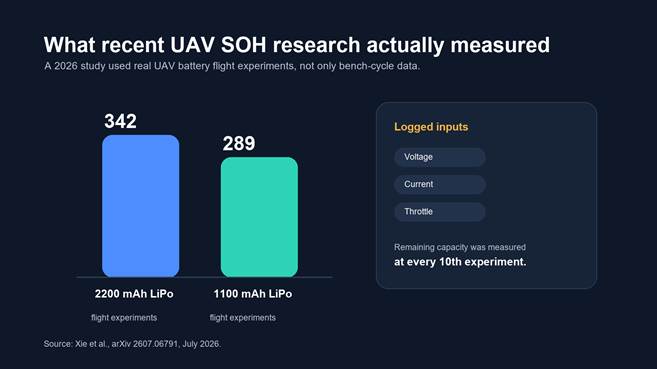
A recent UAV battery SOH study used 631 total flight experiments across two LiPo battery sizes, with voltage, current and throttle as key available inputs. Source: arXiv 2607.06791.
What a Smart BMS should record for industrial drone batteries
A serious industrial drone battery supplier should be able to answer questions that go beyond nominal capacity. Buyers should ask for total watt-hours, nominal voltage, rated capacity, continuous discharge current, peak current and peak duration, charge cut-off voltage, discharge cut-off logic, operating temperature range and recommended charging temperature. These are the basic engineering fields that connect a battery pack to an aircraft and a mission.
For Smart BMS and SOH evaluation, the buyer should go further. Ask whether the pack records cycle count, cumulative charged and discharged amp-hours, highest and lowest cell voltage, maximum temperature, temperature-sensor locations, over-current events, over-temperature events, low-voltage events, cell imbalance, charge termination behavior, firmware version, serial number, production batch and service history. If the supplier claims SOH, ask how it is calculated, what data it uses, whether the estimate is updated after real flights, and how it behaves after storage or abnormal events.
Temperature data deserve special attention. Lithium batteries can overheat and, under severe abuse or damage, enter thermal runaway. The FAA’s lithium battery incident page describes events involving smoke, fire or extreme heat and warns that its list is not a complete record of all such incidents [3]. For drone operators, the practical point is simple: a battery that logs temperature history gives engineers more context than a battery that only looks normal after it cools down.
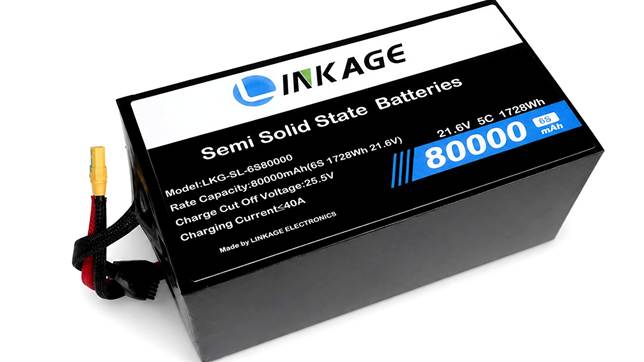
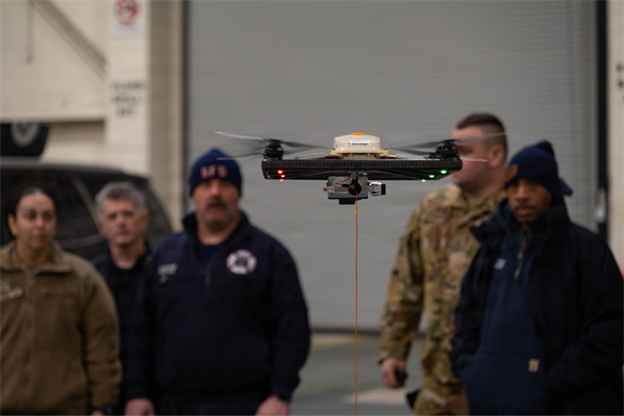
High-capacity UAV packs should be evaluated by pack-level data: Wh, voltage, discharge rating, charging limits, BMS behavior and mission fit. Image: LINKAGE / LKGHK official product page.
The EU is making battery data a serious procurement topic
The European regulatory direction is another reason this topic is becoming more interesting. Article 14 of Regulation (EU) 2023/1542 requires up-to-date parameters for state of health and expected lifetime to be contained in the BMS of stationary battery energy storage systems, LMT batteries and electric vehicle batteries from 18 August 2024. Article 77 requires a battery passport from 18 February 2027 for LMT batteries, electric vehicle batteries and industrial batteries with a capacity greater than 2 kWh [4].
This does not mean every drone battery is automatically covered by the same BMS or passport rule. Smaller UAV packs may fall outside those specific categories. However, the direction is clear: serious battery buyers are getting used to asking for traceability, health data, lifecycle information and documentation. Large industrial drone batteries, especially packs around or above 2 kWh, will increasingly be evaluated with the same mindset. In Europe, a supplier that can provide clean pack data and credible documentation will look more professional than a supplier that only lists capacity and price.
From consumable to data asset: what changes for drone fleets
When a battery becomes a data asset, the fleet operator can make better decisions. Packs can be assigned by mission risk instead of by rough age. A newer, healthier pack may be used for long-range inspection over difficult terrain. A pack with higher resistance growth may be limited to short training flights. A pack that records an over-temperature event can be quarantined and checked before it goes back into rotation. This is not glamorous, but it is exactly the kind of management that keeps industrial fleets reliable.
The financial effect can also be meaningful. Battery packs are a recurring cost. Early retirement wastes money, while late retirement increases risk. If a fleet has no data, it often swings between those two mistakes. SOH data gives the operator a better middle path: retire batteries when evidence says they are no longer suitable for a mission, not simply when the calendar or a handwritten cycle count says so.
This is where semi-solid and high-energy lithium drone packs can be positioned honestly. A high-energy pack should not be marketed only with a headline Wh/kg number. It should be sold as a system: chemistry, mechanical design, BMS, connector interface, documentation and field-support logic. The stronger the energy density claim, the more important it becomes to prove how the pack is monitored in real missions.
What buyers should ask before ordering Smart BMS drone batteries
A practical buyer checklist can separate serious suppliers from weak ones. First, ask whether the quoted energy density is at cell level or pack level. Then ask for total watt-hours, nominal voltage, rated capacity, continuous discharge current, peak current duration, working temperature range and recommended charge temperature. These questions stop a specification sheet from hiding behind one attractive number.
Second, ask whether the pack includes multi-point temperature sensing, BMS data logging, cycle count, SOH estimation and fault records. If the answer is yes, ask for the data format and an example export. A screenshot is not enough for a fleet operator. Useful data should be tied to a battery serial number, a timestamp, a charge or discharge event, and ideally an aircraft or mission record.
Third, ask for realistic flight-test data. A credible supplier should specify the aircraft model, payload mass, weather assumptions, route profile, landing reserve and test method. A flight-time claim without payload, wind, temperature and reserve is not a technical claim; it is advertising. Serious buyers know the difference.
The future direction: battery intelligence will move closer to the aircraft
The next step is tighter integration between battery, aircraft and fleet software. A Smart BMS can record pack-level events, but the aircraft knows the mission profile: climb rate, throttle demand, payload, altitude, wind estimate, vibration, landing reserve and route length. When those datasets are connected, SOH becomes more useful. Instead of saying a pack is 88 percent healthy in isolation, the system can say whether that pack is suitable for a specific mission tomorrow morning.
This is also why smaller sensor sets remain interesting. The UAV SOH study used voltage, current and throttle partly because UAVs cannot always carry the same sensor richness as larger vehicles [1]. The lesson is not that three inputs are always enough. The lesson is that practical drone-battery intelligence must work with lightweight, field-available data. The best suppliers will not overload the aircraft with unnecessary electronics. They will choose the data that improves safety, maintenance and mission planning.
For exporters, this creates a sharper way to compete. Price still matters, but price is easy for customers to compare and easy for competitors to cut. Reliable BMS data, clear SOH logic, pack-level documentation and realistic flight-test evidence are harder to copy. They build trust. In industrial drones, trust often converts better than exaggerated performance language.
Conclusion
Smart BMS and SOH are changing the meaning of a drone battery. The pack is still an energy source, but it is also becoming a record of how the aircraft is used, how the battery ages and how much risk remains before the next mission. For industrial UAV buyers, the winning supplier will not be the one with the loudest capacity claim. It will be the one that can connect energy, safety, documentation and real mission data into one credible battery system.
Sources
[1] Xie, J., Glushkova, A., Awwad, R., Lu, T., and Mavris, D. N. “Machine Learning-Based Battery State-of-health Prediction for Unmanned Aerial Vehicles Predictive Maintenance,” arXiv, 7 July 2026. https://arxiv.org/abs/2607.06791
[2] Federal Aviation Administration. “Compendium to FAA Aerospace Forecast 2026-2046: Emerging Aviation Entrants – Analysis and Forecasts: Unmanned Aircraft Systems and Advanced Air Mobility.” https://www.faa.gov/data_research/aviation/aerospace_forecasts/uas-compendium.pdf
[3] Federal Aviation Administration. “Lithium Battery Incidents.” Last updated 16 July 2026. https://www.faa.gov/hazmat/resources/lithium_batteries/incidents
[4] European Union. Regulation (EU) 2023/1542 of the European Parliament and of the Council concerning batteries and waste batteries. https://eur-lex.europa.eu/legal-content/EN/TXT/HTML/?uri=CELEX:32023R1542
[5] LINKAGE / LKGHK. “LINKAGE 6S 80000mAh Semi-Solid-State Li-ion Battery.” Product specification page. https://lkghk.com/product/linkage-6s-80000mah-semi-solid-state-li-ion-battery/
[6] NASA Open Data. “Li-ion Battery Aging Datasets.” Prognostics Center of Excellence battery-aging dataset. https://data.nasa.gov/dataset/Li-ion-Battery-Aging-Datasets/uj5r-zjdb/about_data
[7] European Commission. “A Drone Strategy 2.0 for a Smart and Sustainable Unmanned Aircraft Eco-System in Europe.” https://transport.ec.europa.eu/transport-modes/air/drones/drone-strategy-20_en